Why Is My BBQ Grill Not Heating Up? 15 Common Causes
A grill that won't get hot enough is one of the most frustrating problems a homeowner deals with. Most causes are diagnosable and fixable — if you know what to look for.
When Your Grill Won't Get Hot Enough
A gas grill that used to reach 600°F in 10 minutes but now struggles to hit 350°F is not just an inconvenience — it is a symptom of something specific. Low heat output in gas grills almost always has an identifiable cause, and in most cases that cause is fixable without replacing the grill.
The challenge is that low heat can come from half a dozen different parts of the grill, and the fix for each one is completely different. Replacing a regulator when the real problem is a blocked burner wastes money and leaves the problem in place. Working through the causes systematically is the only reliable approach.
Below are the 15 most common reasons a gas grill is not heating up — from the simplest checks you can do in two minutes to the component failures that require professional diagnosis and repair.
The 15 Most Common Causes of Low Grill Heat
Regulator Safety Bypass Mode
This is the single most common cause of sudden low heat across all burners simultaneously — and the most frequently misdiagnosed. Propane regulators have a built-in safety bypass that restricts gas flow to a trickle when they detect a rapid pressure drop. It is triggered by opening the tank valve too quickly, leaving a burner knob open when you connect the tank, or by a small leak in the system that the regulator detected. The grill lights, produces a flame, but has no heat to speak of. The fix: Turn off all burners and the tank, disconnect the regulator for 30 seconds, reconnect, open the tank valve slowly and completely, then relight. This resets the regulator in most cases. If the problem returns repeatedly, the regulator itself may need replacement.
Blocked Burner Ports
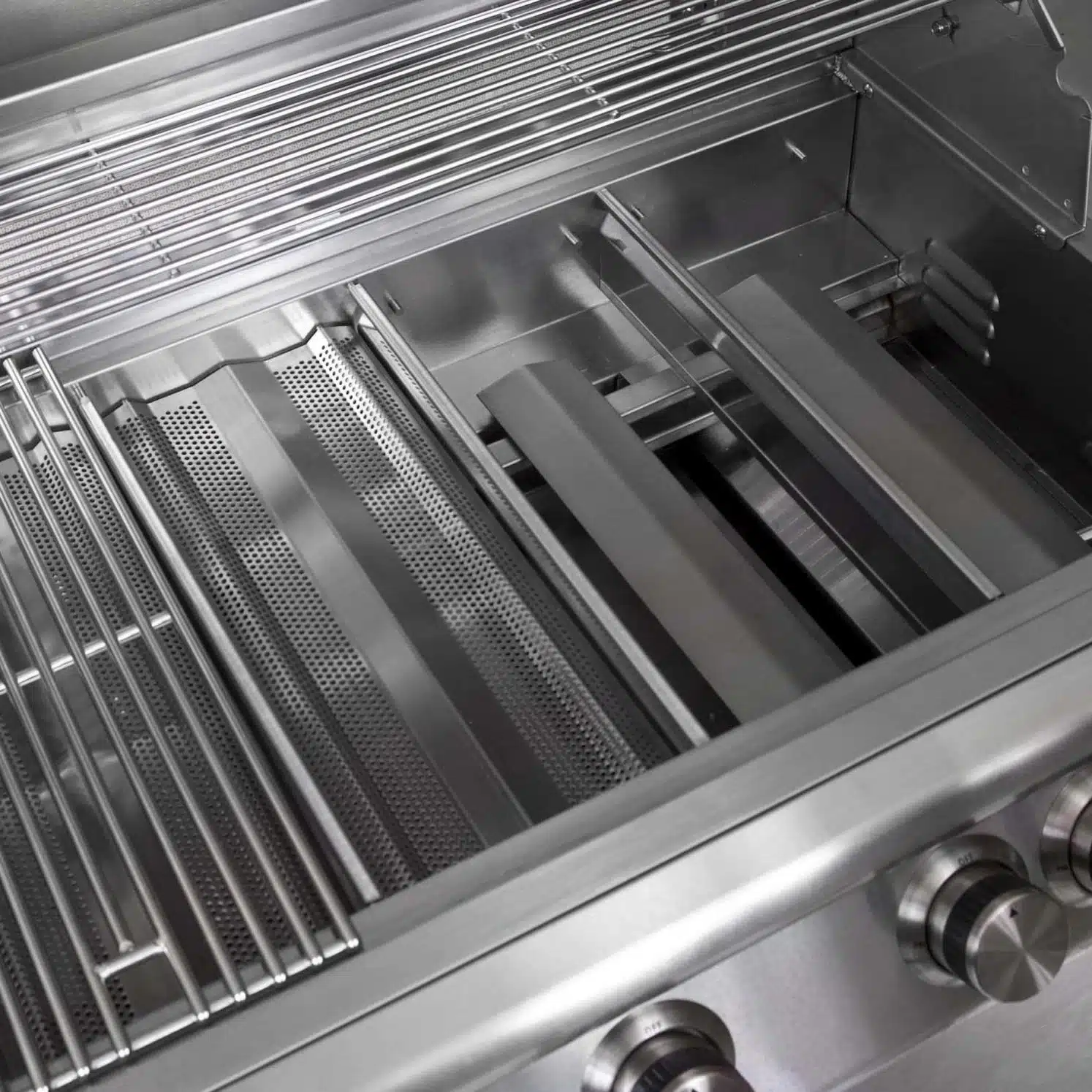
Each burner has a row of small ports through which gas exits to produce flame. When those ports are partially or fully blocked by carbonized grease, spider webs, or debris, gas cannot flow evenly — resulting in weak, patchy flame and significantly reduced heat output. A burner with half its ports blocked produces far less heat than one with all ports clear, even at the same valve setting. This is one of the most common findings during professional grill cleaning and is typically resolved by thorough port clearing rather than burner replacement. See our full BBQ burner guide.
Heavy Grease and Carbon Buildup on Heat Plates
Heat plates and briquette trays sit directly above the burners and distribute heat to the cooking surface. When they are coated in layers of carbonized grease, two things happen: the grease absorbs radiant heat before it reaches the cooking surface, and the buildup restricts airflow around the burner area. A grill with heavily soiled heat plates can lose 100–150°F of effective cooking temperature compared to the same grill with clean components. Regular professional deep cleaning removes this buildup and restores heat distribution. See our briquette trays guide.
Low or Nearly Empty Propane Tank
A propane tank that is running low produces lower pressure than a full tank, which reduces gas flow to the burners and lowers heat output noticeably. This is one of the easiest causes to check and rule out — weigh the tank, use a hot water test to estimate fill level, or simply swap for a full tank and see if heat performance improves. It sounds obvious but a surprising number of service calls involve a tank that is close to empty. Always check the tank first before investigating more complex causes.
Faulty or Aging Regulator
Beyond the bypass mode issue, regulators physically degrade over time. The internal diaphragm that controls pressure can harden, crack, or deform — reducing the consistent pressure delivery the burners depend on. A regulator that is 5 or more years old and producing consistently low flame across all burners, even after the bypass reset procedure, may simply be worn out and due for replacement. Regulator replacement is a relatively straightforward repair that restores normal gas pressure and heat output.
Degraded or Failed Burners
Cast iron and stainless steel burners deteriorate over years of use. Cast iron burners rust — particularly in Southern California's coastal environments — and develop cracks and crumbling sections that allow gas to escape from unintended locations rather than through the designed ports. Stainless steel burners warp and develop holes along the body of the tube. A burner with physical deterioration cannot distribute gas efficiently and produces lower, uneven heat even when all ports are clear. When thorough cleaning does not restore heat, burner condition is the next thing to assess. See our BBQ burner guide.
Warped or Damaged Heat Plates
Heat plates that have warped significantly from years of high-heat cycling no longer sit flat above the burners. Warped plates create gaps in heat distribution — hot zones directly above exposed burner ports and cold zones where the plate has bowed away from the burner. Even if the burners themselves are functioning correctly, warped heat plates produce uneven and generally lower effective cooking temperatures. Replacement of warped or cracked heat plates is typically straightforward. See our briquette trays and heat plates guide.
Partially Closed or Malfunctioning Valve
A control valve that does not open fully — due to internal wear, corrosion, or physical damage — restricts gas flow even when the knob is turned to the high position. The grill appears to be on high but the flame is weak and heat output is well below what the knob position suggests. This is distinct from the regulator bypass issue because only the affected burner shows low output, while other burners perform normally. See our detailed valve diagnosis guide.
Spider Webs or Insect Nesting in Burner Tubes
Certain spider species are attracted to the residual gas scent inside burner tubes and spin webs inside the tube body — not just at the ports. A web inside the burner tube restricts gas flow through the entire burner, not just in individual ports, and can reduce heat output dramatically. This is particularly common in Southern California on grills that have sat unused for a few weeks or longer, and is one of the most common findings on grills that suddenly develop heat problems after a period of non-use. Inspect burner tubes visually and check for blockage before any other diagnosis.
Kinked, Pinched, or Damaged Gas Hose
The flexible gas hose connecting the regulator to the grill manifold can develop kinks, pinches, or damage that restricts gas flow. This is more common on grills where the hose runs in tight spaces around cabinetry or where the grill has been moved and the hose was bent sharply. A partially kinked hose produces the same low-heat symptoms as a failing regulator — reduced flame across all burners. Inspect the full length of the hose for visible damage, and replace it if any constriction or cracking is found.
Grill Lid Left Open During Preheat
This sounds too simple but it is one of the most common reasons a grill "doesn't get hot enough" — the lid is left open during preheat. A gas grill is designed to heat in a closed environment. Heat escapes continuously with the lid open, and the grill temperature measured at grate level is a fraction of what a closed lid produces. Always preheat with the lid closed for at least 10–15 minutes before cooking. If your grill reaches the expected temperature with the lid closed but not with it open, this is your answer — not a mechanical problem.
Natural Gas Supply Pressure Issue
For natural gas grills connected to a home's gas supply, low heat can be caused by insufficient gas pressure at the supply rather than anything wrong with the grill itself. This can happen if other high-demand appliances are running simultaneously, if the supply valve to the grill is not fully open, or if the gas line servicing the outdoor kitchen is undersized for the grill's BTU requirements. Check that the supply shutoff valve is fully open. If pressure seems consistently low, contact your gas utility or a licensed plumber to assess line sizing and pressure.
Extreme Wind Conditions
Strong offshore winds — including the Santa Ana wind events common in inland Orange County — can dramatically reduce effective grill temperature by drawing heat away from the cooking chamber faster than the burners can replace it. Wind also disrupts the air-to-gas mixture at the burner ports, producing a weaker and less consistent flame. If low heat only occurs on windy days and the grill performs normally in calm conditions, wind management — positioning, windbreaks, or adjusting cooking technique — is the solution rather than a repair.
Worn or Poorly Fitting Grill Grates
Grates that have warped over years of high-heat use no longer sit flat at the correct height above the burners and heat plates. This changes the heat transfer relationship between the heat source and the cooking surface, resulting in uneven heat and lower effective cooking temperatures at grate level even when the grill's internal temperature is normal. Combined with grease buildup on the grates themselves absorbing heat, worn grates can contribute meaningfully to reduced cooking performance. See our grill grates guide.
Manifold or Multi-Valve Assembly Failure
On premium built-in grills, the manifold — the main gas distribution pipe that feeds all the individual valves — can develop corrosion, hairline cracks, or connection failures that reduce pressure across the full system. This is a less common failure mode but worth including because it is frequently the last thing homeowners suspect. Manifold issues produce symptoms that mimic regulator failure — low pressure across all burners — but persist after regulator replacement. Professional diagnosis is required to confirm a manifold problem, as it is not visible or testable without disassembly.
Quick Diagnosis: Which Type of Low Heat Do You Have?
Low heat on ALL burners simultaneously — Start with the regulator bypass reset (Cause 1). Check tank level (Cause 4). Inspect gas hose for kinks (Cause 10). Check natural gas supply valve if applicable (Cause 12).
Low heat on ONE specific burner — Inspect that burner's ports for blockage (Cause 2). Check for spider webs inside the burner tube (Cause 9). Assess valve function for that burner specifically (Cause 8). Check burner physical condition for deterioration (Cause 6).
Low heat that developed gradually over months — Grease and carbon buildup on heat plates (Cause 3) and blocked burner ports (Cause 2) are the most likely culprits. A professional deep clean is the first appropriate response.
Low heat that appeared suddenly after non-use — Spider webs in burner tubes (Cause 9) and the regulator bypass mode (Cause 1) are the two most common causes of sudden performance drop after the grill has sat unused.
What You Can Check Yourself vs. When to Call a Professional
Check These Yourself First
- Tank level — weigh it or use a hot water test
- Regulator bypass reset — 30-second disconnect procedure
- Lid position during preheat — always closed
- Supply valve position — confirm fully open
- Gas hose — visual inspection for kinks or damage
- Burner tubes — visual inspection for visible spider webs
- Wind conditions — note if low heat only occurs in wind
Call a Professional When
- Basic checks do not identify the problem
- Burner ports need thorough clearing and inspection
- Heat plates, briquette trays, or burners need assessment
- A valve is suspect and needs proper diagnosis
- The grill has not been professionally cleaned in 1+ years
- The problem is on a premium built-in where disassembly is complex
- There is any gas smell alongside the heat issue
The Most Overlooked Fix: Professional Deep Cleaning
In our experience servicing grills throughout Orange County and Southern California, the majority of "grill not heating up" calls involve a combination of blocked burner ports and grease-saturated heat plates — both of which are resolved by professional deep cleaning rather than part replacement.
A grill that has not been professionally cleaned in a year or more will almost always show meaningful heat performance improvement after a thorough service. The grease on heat plates absorbs heat, the blocked ports reduce flame output, and the combination can make a grill feel like it has lost half its heating capacity — when the actual issue is accumulated maintenance debt rather than component failure.
If your grill is producing low heat and has not been professionally serviced recently, a deep professional cleaning is the right first step before any component replacement is considered. It is also the most cost-effective diagnosis — if cleaning restores full performance, you have your answer and avoided the cost of parts replacement.
Frequently Asked Questions
My grill used to reach 600°F but now maxes out at 350°F — what happened?
A gradual decline from maximum to moderate heat temperature over time is almost always caused by accumulated grease and carbon on heat plates reducing heat transfer, combined with partially blocked burner ports reducing flame output. The grill has not "worn out" — it has built up a maintenance deficit that a thorough professional cleaning typically resolves. If cleaning does not restore full temperature, the next step is assessing burner condition and regulator function.
Could a gas leak cause my grill to lose heat?
Yes — a small leak in the gas supply system reduces pressure available to the burners, which manifests as lower flame and heat output across the grill. More importantly, a gas leak is a safety concern that should be addressed regardless of its effect on heat performance. If low heat is accompanied by any gas smell, turn off the gas at the tank and do not use the grill until it has been professionally inspected.
How do I know if my grill's regulator is bad?
First try the bypass reset procedure (turn everything off, disconnect the regulator, wait 30 seconds, reconnect, open tank valve slowly). If normal heat returns, the regulator went into bypass mode but is not actually failed. If low heat persists after the reset across all burners, and you have confirmed the tank is full and the hose is undamaged, the regulator is the likely culprit. A regulator that consistently enters bypass mode or produces consistently low pressure even after resetting should be replaced.
Is it safe to keep using a grill that is not heating properly?
It depends on the cause. A grill with dirty heat plates and blocked burner ports is not a safety hazard, just a performance issue. A grill with a gas smell alongside low heat, evidence of a gas leak, or compromised gas components should not be used until inspected. When in doubt, a professional inspection before continued use is the right call.
My new grill is already not heating properly — is it defective?
On a new grill, low heat is most commonly caused by the regulator bypass mode triggered during the initial setup — opening the tank valve too quickly or leaving a burner knob open while connecting the regulator. Try the bypass reset procedure before concluding the grill is defective. If the problem persists on a grill under manufacturer warranty, contact us — we perform warranty-authorized repair work for a number of major brands.
Related Resources
- BBQ Grill Repair & Diagnostics
- Professional BBQ Grill Cleaning
- BBQ Grill Burners — Cleaning, Repair & Replacement
- BBQ Grill Valves — Diagnosis & Repair
- BBQ Igniters & Ignition Systems
- Briquettes & Briquette Trays
- Grill Grates — Materials, Maintenance & Replacement
- BBQ Grill Inspections
- Is It Worth Repairing a Barbecue?
- How Much Does Grill Cleaning Cost?
Grill Not Getting Hot Enough? We'll Find Out Why.
SoCal Grill Masters diagnoses and resolves low heat issues on all major grill brands throughout Orange County and Southern California. We identify the actual cause before recommending any repair or part replacement.